
Before There Was Buc-ee's: 20 Historic Gas Stations Worth the Detour in Texas
In a stretch of the 20th century, a gas station wasn't just a place to fill your tank — it was an argument. Oil companies built these things like small monuments, betting that a driver bored on a long Texas highway would remember the one with the Art Deco tower, or the Tudor revival cottage roofline, or the pumps tucked under a porte-cochere like at a hotel entrance. For a few decades, “stop for gas” and “stop and look at something” were the same errand.
Most of those stations didn't survive the interstate system, the oil embargoes, or plain old Father Time. But a surprising number did, restored by preservation organizations, adopted by private owners who fell in love with a uniquely shaped building or a stepped Art Deco tower, or simply left standing long enough thfor someone to finally notice what they were. I went looking for 20 of them, spread from the panhandle to the border, that you can actually visit today. No hauntings required for this list - just genuine roadside history, some excellent architecture, and a few stories about the people stubborn enough to keep these buildings alive.
The Mother Road Still Delivers
Texas claims 178 miles of Route 66 through the Panhandle, and it's still the best place in the state to gas-station-hop. Start in Shamrock, where the Tower Station and U-Drop Inn Cafe rise is up out of the flatland like something from a different, more confident era. An 8-year-old girl won the cafe's naming contest in 1936; the architect sketched the building's flared towers from a concept a local scratched in the dirt. It went dark after I-40 bypassed the town, sat empty through the '90s, and came back in 2003 as a museum thanks to a $1.7M restoration. If the towers look familiar, that's because they inspired Ramone's body shop in Cars.
I’ll be heading to the Mother Road at the end of October 2026, so follow me on Facebook, Instagram, and/or TikTok to see the history and hauntings it has to offer.
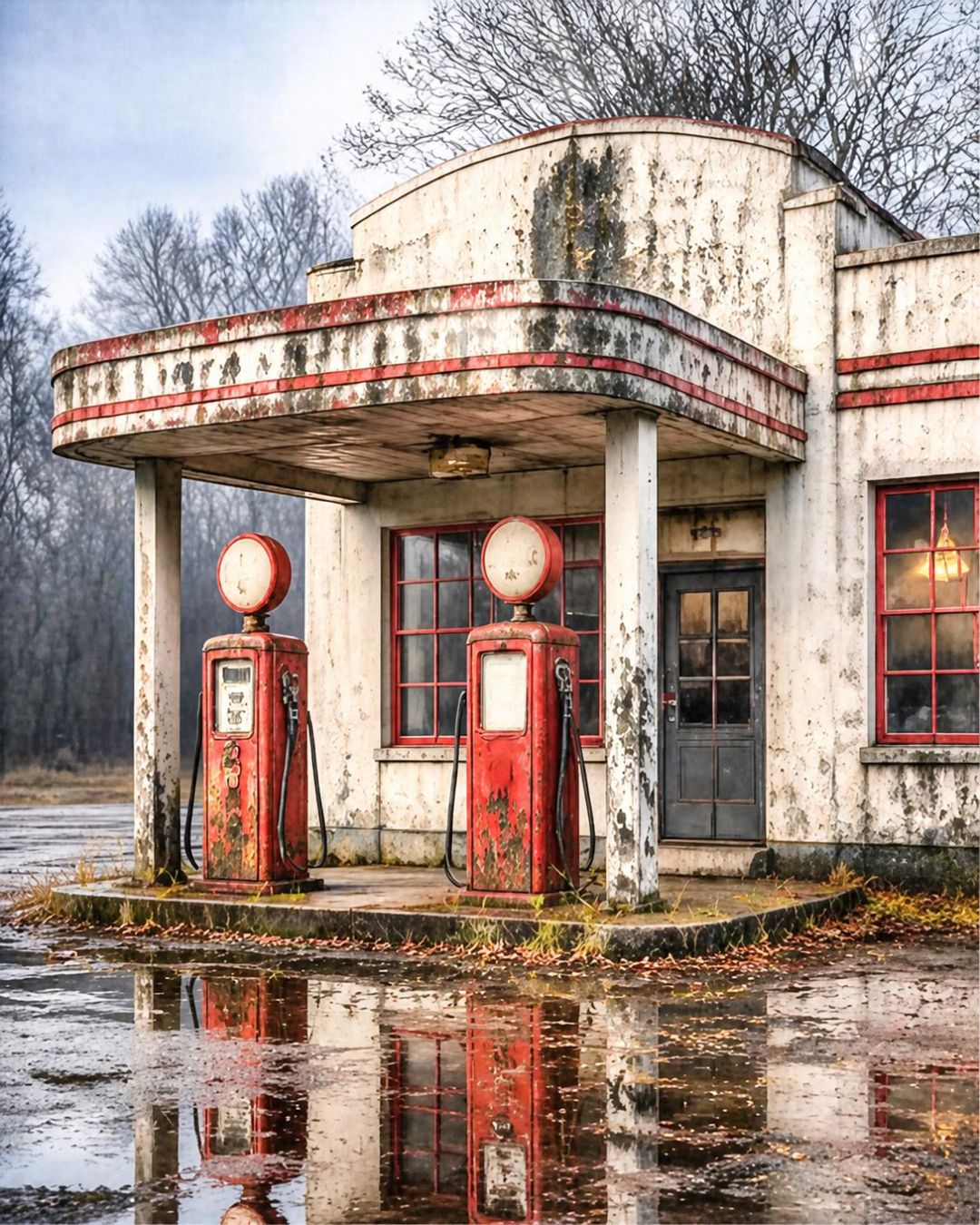
Head West and you'll hit McLean, home to the first Phillips 66 station ever built in Texas - a Tudor revival cottage that pumped gas for more than 50 years. It's parked not far from the Devil's Rope Museum, so you can do barbed wire history and gas station history in the same afternoon —an itinerary I didn't expect to recommend but absolutely do.
Keep going, and the towns get smaller, and the buildings get lonelier. Alanreed peaked at 500 people during the 1927 oil boom and has maybe 50 residents now; its restored 1930 Bradley Kaiser Super “66” station is one of the only things still standing with its exterior intact. Vega's 1924 Magnolia Service Station has kept its round-top pumps in its port cochere through a century of Panhandle wind. And in Adrian — which insists, correctly, that it sits at the exact geographic midpoint of Route 66 - the Bent Door Cafe and Midway Station started life as a WW2 guard shack before someone trucked it in and gave it an angled front door that's been confusing photographers ever since.
Two more are worth the detour even though they're not fully restored. Turkey, out on what used to be Bankhead Highway, has the actual first Phillips 66 station in Texas history — a private owner spent years bringing the Tudor revival building back to life, though it's his getaway now, not a museum, so you're admiring this one from the sidewalk. And in Jericho, a town so thoroughly erased that only foundations remain, the site of Eula and K.C. Reed’s old Texaco station is really a study in absence: a town that had a service station, a garage, and a tourist court, and now has outlines in the dirt and a cemetery that’s somehow still in use.
Where the Gas Stations Got Strange
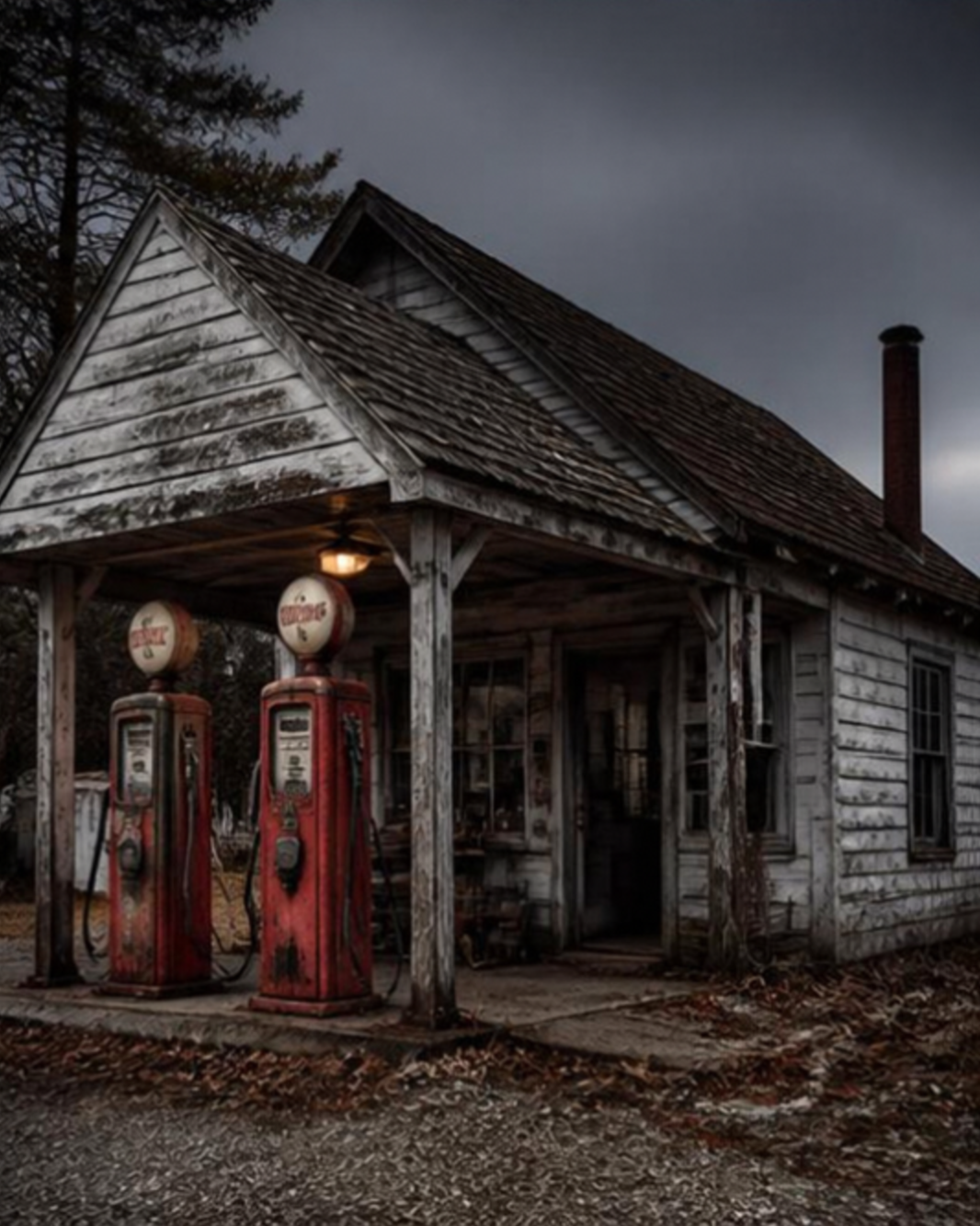
Somewhere in the South Plains, roadside advertising stopped being subtle. In Matador, Bob's Oil Well is a filling station and cafe with a full-scale wooden oil derrick built directly over the pumps — 1930s programmatic architecture at its most gleefully literal, built to catch the eye of anyone driving Highway 70. It's opened and closed more than once over the decades, but now it remains as a reminder of days past.
Snyder has the best shape of any station on this list: the Triangle Sinclair Station, built in 1932 on its own triangular city block, floor plan and all. It was restored in 2011 and is now something between a museum and a clubhouse — travelers stop from all over the world. Nearby Ralls has its own early Phillips 66 station on US-82, a quieter stop but a real one.
The Ones That Just Refused to Fall Down
Some of these buildings survive out of pure stubbornness. Bryan's 1933 Old Sinclair Station was listed on the National Register of Historic Places in 7 and stands on South Texas Avenue, a straightforward Depression-era roadside architecture that's outlasted most of what was built around it. In El Paso's Manhattan Heights neighborhood, a 1919 station—one of the oldest gas stations left in the state—was restored around 2008 and now anchors a public pocket park; the county historical society owns it and is slowly bringing back an original pump.
And then there’s San Antonio's Brown Humble Service Station, believed to be the last Humble Oil station of its kind in Texas. It's sealed up — bricked windows, no public access — but the original mosaic tile sign reading “Humble Oils” is still there, which is the kind of detail that survives specifically because everyone assumed the building itself wouldn't.
Fort Worth and Dallas Kept Theirs, Too
The metroplex has a genuinely good little circuit. Fort Worth's Firestone service store, completed in 1930 on West 7th Street, was the city's first — a recognized piece of the old “Automobile Row” that’s since been converted for other retail. A few miles south, the historic Sinclair Service Station on McCart Avenue is the showpiece: restored in 2010, complete with working-era pumps, a Sinclair-branded truck usually parked under the canopy, and the brand's dinosaur mascot still perched on the roof. It won a preservation award the year after it reopened, and it's easy to see why.
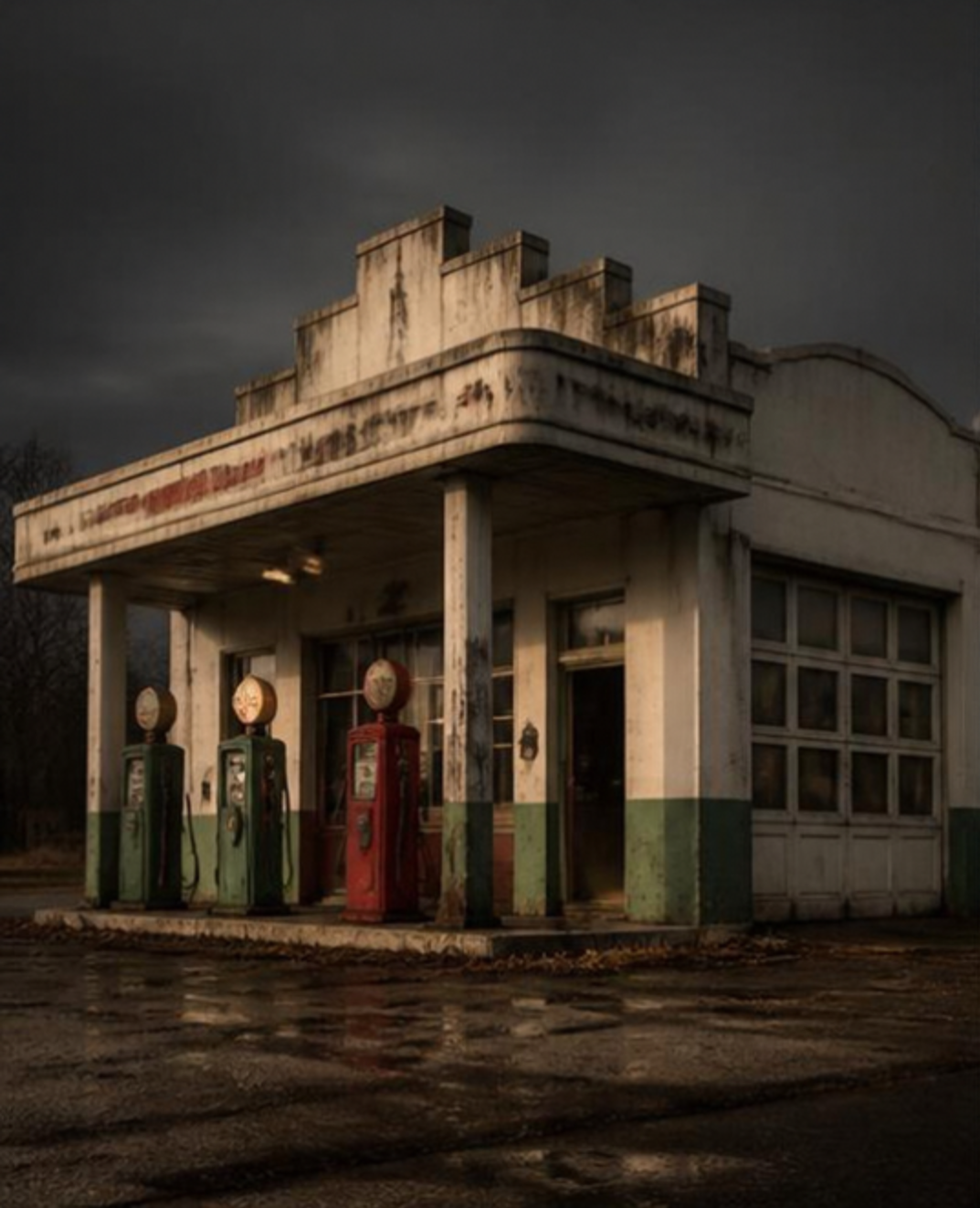
Dallas's contribution is the Good Luck Gas Station, one of only three Art Deco gas stations ever built in the city. Its 35-foot stepped tower went up in the winter of 1939, survived the 1973 oil embargo closure and an arson fire in the early 90s, and now functions as office space — a registered city landmark you can admire from Cadiz Street even though you can't walk in.
Central Texas: a Hobby That Got Out of Hand
My favorite story on this whole list belongs to Waco. In 2014, Brothers Gary and Randy Balusek restored a 1929 Gulf station on Washington Avenue for no better reason than wanting somewhere to hang out and work on old cars. It has four period-correct pumps and a driveway service bell that still rings — no fuel dispensed, no admission charged, just a genuinely well-loved piece of Americana that exists because two guys wanted it to.
Then there's Bastrop, which takes the “historic gas station” premise completely elsewhere. The early-1900s filling station there was used as a filming location for the Texas Chainsaw Massacre in 1974, and instead of letting that reputation quietly fade, the current owners leaned all the way in - it's now a barbecue restaurant and horror-movie gift shop that promises, on a sign out front, to serve “beef and pork barbecue, not people.” It's the most purely fun stop on this list and, unlike a few others, you can walk right in.
Terlingua Never Really Stopped
Out in Big Bend, the old company trading post and gas pumps from Terlingua’s early-1900s mercury mining boom didn't get frozen in amber like most ghost towns — they got absorbed into a town that's still, and improbably, alive. The Starlight Theater Restaurant, a hotel, and a handful of shops now operate around those original structures, which makes Terlingua less a museum piece and more a place with an unbroken pulse, just a much quieter one than it had in 1910. You can see one of the historic pumps outside the Terlingua Trading Company.
And a Ghost Town Worth the Windshield Time
Not every stop on this circuit is a going concern. Glenrio, straddling the Texas-New Mexico line, once hosted three weeks of location filming for The Grapes of Wrath and now has only a handful of residents—sometimes zero. Its gas station sign still reads both directions: “First in Texas” one way, “Last in Texas” the other, which might be the state’s best piece of roadside signage. The buildings are fenced off, so it is a look-don't-touch stop, but it's worth the frontage-road detour off I-40 for that sign alone.
Planning The Trip
A few practical notes if you're building an actual itinerary out of this: Turkey, Jericho, and Glenn Rio are all private property or unmarked ruins, so budget those as photo stops from public roads rather than full visits. Bob's Oil Well in Matador and a couple of the smaller stations don't keep predictable hours, so a quick phone call ahead saves you a wasted trip. And if you want to do this properly, the Route 66 panhandle corridor - Shamrock, McClean, Allenreed, Jericho, Vega, Adrian, Glenrio - strings together beautifully along the old highway alignment, while Fort Worth and Dallas make an easy pair if you'd rather keep your road trip inside the metroplex.
What strikes me most, station after station, is how much these buildings were designed to be noticed. Somebody in 1930's Snyder decided a gas station should be shaped like a triangle. Somebody in Matador decided the best way to sell gasoline was to build an oil derrick over the pumps. Somebody in Shamrock talked an architect into flared Art Deco towers for a building that mostly sold Conoco fuel and pie. None of that was necessary. All of it is still standing, in one form or another, waiting for you to pull over.
The Last Word
Buc-ee's will still be there when you get back, with its 120 pumps, beaver mascot, and everything else. But it will also be exactly the same Buc-ee's as the one 40 miles down the road, and the one after that. Nothing on this list is the same as anything else, and that's the whole point. Somewhere between the oil bust and the interstate bypass, Texas quietly built itself a museum with no walls and no admission fee. You just have to know where the exits are.
So next time your tank is getting low, skip the chain you already know by heart. Take the old highway instead. Pull over for the triangle-shaped station, the one with the derrick on the roof, or the one that used to be a Greyhound stop and is now also a bar. Text me the one I missed—twenty on the first list, twenty more on the second, and I already know this state isn't done surprising me.
Make this beautiful day count!
Annette