
The Town that Cotton Built & Hollywood Borrowed: A Historic Walk Through Bartlett, TX
There’s a reason Hollywood keeps coming back to Bartlett. When the crew of The Newton Boys needed a 1920s Texas cotton town, they didn’t build one. They drove an hour northeast of Austin, parked on Clark Street, and started filming. NBC did the same thing years later for Revolution, a series about a world wher the power has gone out for good. Fear the Walking Dead used downtown as a ghost town. The Stars Fell on Henrietta, The Whole Wide World, a Texas Chainsaw picture or two, and Taylor Sheridan’s 1923 have all shot here. Bartlett, it turns out, is very convincing as a place time forgot.
That’s not an insult. It’s the whole reason to visit.
A Quick History
Settlers had been drifting into this stretch of blackland prairie since the days of the Republic, but the town itself didn’t exist until the railroad decided it should. In 1881 the Missouri, Kansas, and Texas suveyed a line through the area, and two men, Capt. John T. Bartlett and German immigrant J. Edward Pietzsch, donated the land for a townsite. The tracks arrived in 1882. By 1884 there was a gin, a hotel, four churches, and about 300 people. By 1890 the town had incorporated, the two newspapers, a bank, and a waterworks.
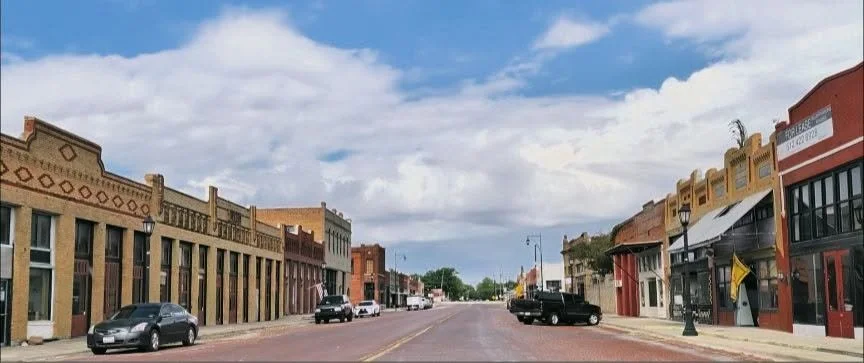
The cotton did what cotton does. Bartlett paved its main street in brick in 1900 and had electric lights by 1905, years before most Texas towns its size. It built its own shortline, the Bartlett Western, running west toward Florence, and became the shipping point for everything grown in the surrounding counties. By 1914 the population had climbed to around 2,200, with three gins and three banks. That’s the Bartlett you see on Clark Street today: brick, confident, and built to last.
The crash came fast. The Bartlett Western went bankrupt in 19365, the Depression finished the job, and the town spent the next sixty years quietly shrinking. Nobody had the money to tear anything down and rebuild. Which is why nearly ninety percent of the buildings in the historic district are original, contributing structures.
One more detail that gives Bartlett its odd charm: the town sits directly on the line between Bell and Williamson counties. The line runs roughly east-west through the middle of town, and several homes and businesses straddle it. The old First National Bank on Clark Street did its business in a building that sat in both counties at once.

The Historic District: Clark Street
Where: E. Clark Street between the railroad tracks and Highway 95
Start here. Two blocks of early-1900s storefronts on a wide street paved in hand-laid red brick, listed on the National Register of Historic Places in 1980. Walk it slowly. Look up at the comices and down at the cast-iron thresholds still bearing the names of businesses that closed before your grandparents were born.
The showpiece is the Bartlett National Bank at 200-210 E. Clark, established 1904. It’s a one-story cream brick building with plaster eagles on two facades, Ionic pilasters, and a general air of Beaux-Arts self-importance that a town of 2,200 people probably didn’t need but clearly wanted. It’s also a place you can spend the night: the building has been converted into a guest house, and the original vaults are still inside. More on that below.
Two state historical markers stand together at 140 W. Clark: one founding of the city, and one for the Woman’s Wednesday Club, a study club formed in 1903 that went on to start the town’s first public library and its early Red Cross chapter. Small towns ran on women like these.

The 1909 Schoolhouse
Where: 300 W. Bell Street
This is the one that will stop you. In 1908 the Bartlett school district, flush with cotton money, hired Austin architect A.O. Watson to design a brick school on a full city block. Watson gave them something strange and wonderful: a sixteen-sided building, one of three he designed in Texas. The other two, in Alpine and Austin, were torn down long ago. This is the last one standing.
It cost about $21,000, opened in 1909 with 250 students, and served every grad until a separate high school opened at the end of the decade. After that it was the elementary school, then the primary school, until it finally closed in 1988.
It very nearly didn’t survive that. That building was slated for demolition when a Save Our School group formed in 1990, and the next year the Bartlett Activities Center took a hundred-year lease on it from the school board. They’ve been restoring it ever since. The ground floor is now a local-history museum, the upstairs classrooms are preserved as they looked when children sat in them, and one room has been turned into a parlor for receptions. A state marker stands out front.
Three Churches, Three Markers
Bartlett’s historic churches are all within a few blocks of each other and all carry Texas Historical Commission markers, which means the histories are literally posted on the lawn. Two are still congregations. One is something else entirely.
First Baptist Church, 210 W. Bell St. Organized in 1873 as Pecan Grove Baptist Church by three ministers, one of whom, G.W. Baines, was the great-grandfather of Lyndon Johnson. The congregation moved to Bartlett in 1884, and the present brick sanctuary went up in 1930. Six years later the members had paid off every cent, and on Sunday morning, December 13, 1936, they burned the note in a ceremony right here. The lot itself was a gift from J.E. Pietzsch, the town’s Lutheran co-founder, which tells you something about how small towns actually worked.
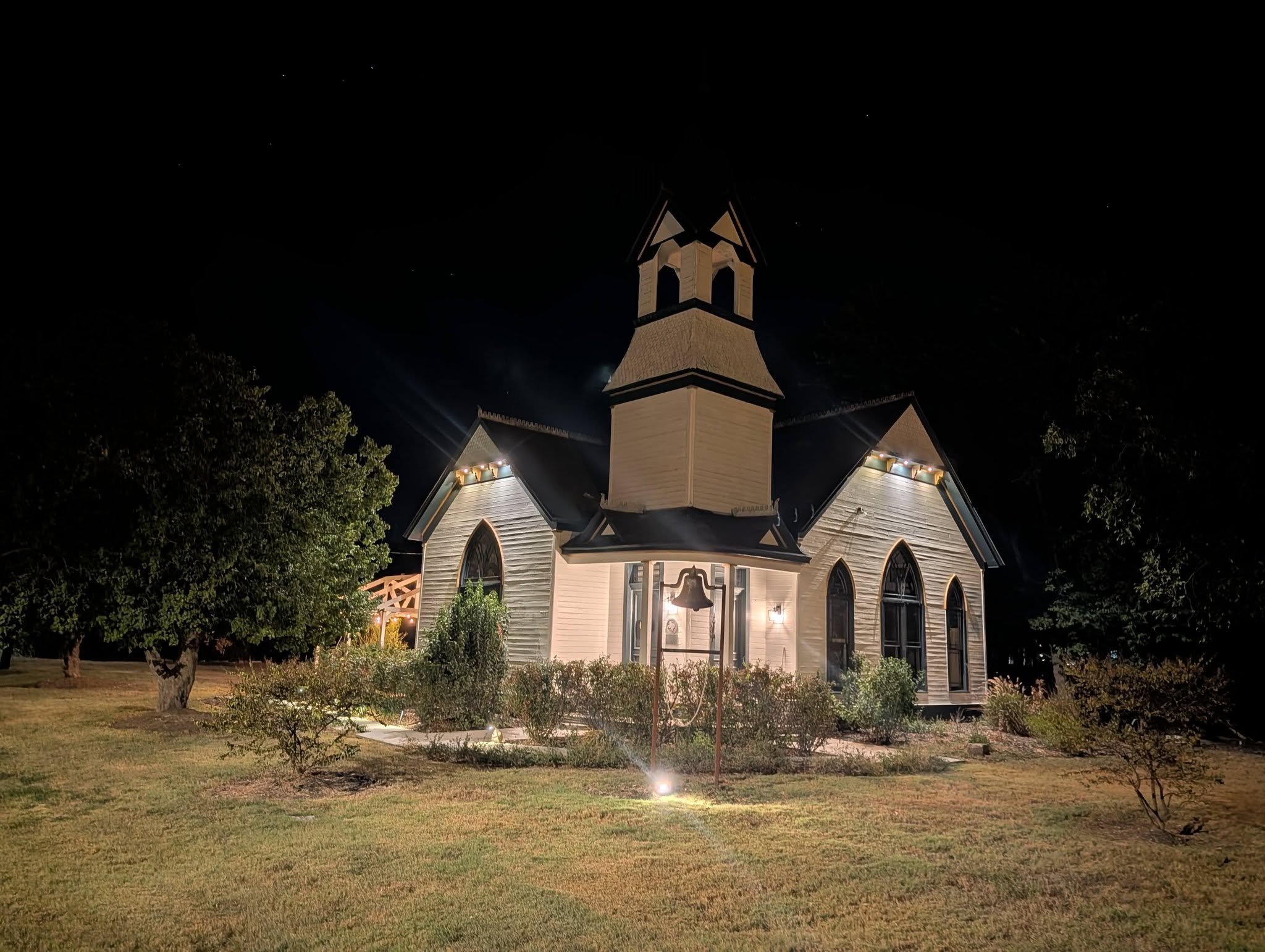
First Presbyterian Church, 346 W. Pietzsch St. The prettiest of the three, and the strangest story. A Victorian sanctuary built in 1899 and designated a Recorded Texas Historic Landmark in 1970, for a congregation dwindled and the building sat abandoned for decades. In 2021, a preservationist bought it and spent about seven months turning it into a three-bedroom rental. The pews came out, the choir loft became a dining room, and you can now sleep in it. If you’re staying overnight in Bartlett, it’s this or the bank vault.
First United Methodist Church, 645 W. Clark St. Also born on Indian Creek around 1870-1875, the Methodist held services in a store, a schoolhouse, and Baptist church before finally building their own in 1890. The current sanctuary dates to 1896 and was enlarged in 1912.

The Other Bartlett
A cotton town needed hands every fall, and every fall Black laborers and their families came to pick. Some stayed. Their history is marked too, and it’s the part of town most visitors skip.
Mount Ararat Missionary Baptist Church, 529 S. Bowie St Founded in June 1898 by two families, Thomas Sanders’s and Nelson Secret’s, who sent to Temple for a preacher. For its first eighty-two years the church was called Mount Arie, until someone finally looked it up and realized the founders had meant Ararat, the mountain where the Ark came to rest. The building was moved to Bowie Street in 1953 because the ground under its old Brook Street site kept shifting. The congregation is still active.
Site of the Bartlett Colored School, Arnold Drive west of Cotrell Street. When the district built its brick school in 1909, it dragged the old six-room frame schoolhouse to this lot and made it the first school for Black Students. It burned in 1919 and was rebuilt from salvaged lumber. for decades it only went through the tenth grade, finishing high school meant getting yourself to Temple or Austin somehow. That changed after the Powells arrived from Prairie View A&M in 1946 and pushed the school to twelve grades within a year. Only a marker remains.
Site of the Booker T. Washington School, 200 Cryer Drive. After a 1948 bond issue, the district bought four surplus buildings from Camp Swift in Bastrop and hauled them here, to the site of the town’s old Civilian Conservation Corps camp. The school opened in the fall of 1949 and took the Booker T. Washington name in 1957. Under coach and principal Gentry “Prof” Powell, it became a district and state champion in football and track before Bartlett integrated in 1965.

The Bank Marker
Where: 206 S. Dalton Street
A marker for the First National Bank of Bartlett stands at the 1968 building on S. Dalton, but the story is about the earlier one. Jesse Bailey and his son Charles opened a private bank inside their mercantile in 1898; it became First National in 1990 and operated out of that county-line-straddling building on Clark Street for nearly seventy years.
Beyond the City Limits
Everything above is walkable in about half an hour. The rest will need a car.
St. John Lutheran Church and German-English School, 30650 TX-95, north of town. The Pietzsch family held the first Lutheran services in their home; in 1880 a combined church and school went up on land given by John Bartlett. The school taught in English through the winter and German through the summer, and closed in 1948. A 1922 fire took the parsonage and every written record the congregation had. German-language services ended in 1942, for reasons you can guess. The present church dates back to 1931.
Bartlett Electric Cooperative marker, TX-95 about three miles north or town, in Bell County. The founding families are buried here. What’s more interesting is what lies just outside the fence: two older, unfenced burial grounds that the city maintains but doesn’t much advertise, including one that Find-Grave lists simply as the “Old Black Cemetery.” Go in daylight and go respectfully.
Stockton Family Cemetery, Stockton Road, northwest of town in Bell County. Established in April 1890 when the Stocktons buried their 15-year old son on land they farmed since 1870. More than eighty graves now, still in use by descendents. Among them: Ead White, a formerly enslaved man who stayed with the familyy after the Civil War, and three family members who drowned together in the 1919 Corpus Christi hurricane.
Donahoe, Donahoe Road at Post Oak Road, east of Bartlett. A ghost town in the plainest sense. Settled along Donahoe Creek in the late 1840s, it once had a town square, a post office, a telephone exchange, and a voting precinct. Then better roads were built to other towns, and Donahoe simply stopped. The cemetery is all that’s left.
Ghosts & Getaways · City Guide
Bartlett, Texas
A two-block time capsule on the Bell–Williamson county line. Seventeen stops, one thin ghost story, and a ghost town down the road.
Most of the places I write about earned their reputation the hard way: a fire, a murder, a hundred years of people saying they saw something. Bartlett didn’t. Its only tragedy was economic. Cotton left, the railroad went broke, and the town spent the better part of a century waiting for a future that never came.
So go walk Clark Street. Sleep in the bank or the church if you can manage it. Bartlett may not have a ghost story yet, but it has everything a ghost story needs, and it has been patient for a very long time.
Make this beautiful day count!
Annette